Custom AI Agents vs. Off-the-Shelf Solutions: Making the Right Choice
By: Sadellari Enterprises - 2026-02-08
Custom AI Agents vs. Off-the-Shelf Solutions: Making the Right Choice
By 2026, AI agents are no longer a novelty. They are running real operations — handling customer inquiries, processing financial data, coordinating supply chains, and supporting executive decision-making around the clock. The question for most businesses has shifted from "should we deploy AI agents?" to "how should we deploy them?"
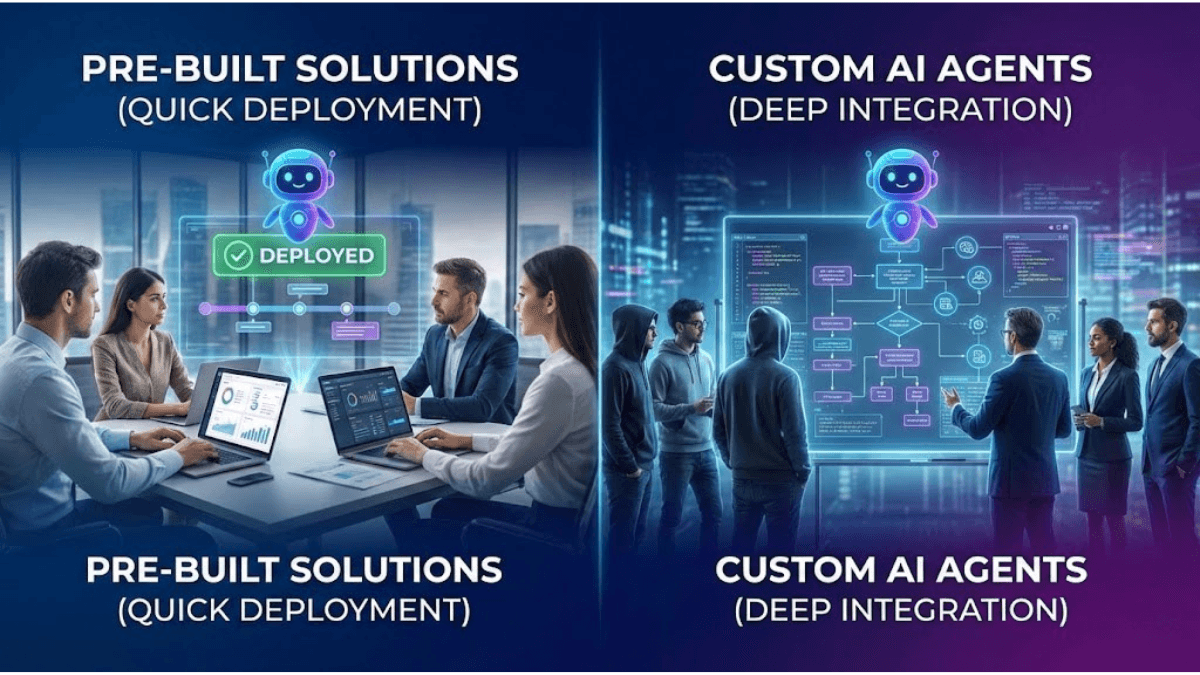
That question almost always leads to the build-vs-buy decision. Should your organization invest in custom AI agent development tailored to your exact needs, or should you adopt pre-built, off-the-shelf solutions that offer faster time to value? The answer, as with most strategic technology decisions, depends on your specific circumstances. And increasingly, the smartest answer lies somewhere in between.
This guide provides a practical framework for navigating this decision — helping you understand when custom development delivers superior returns, when off-the-shelf solutions are the right call, and how a hybrid approach often captures the best of both worlds.
The Build-vs-Buy Spectrum
The first thing to understand is that build-vs-buy is not a binary choice. It is a spectrum with many intermediate options:
Pure Off-the-Shelf
Deploy a pre-built agent with standard configuration. Minimal setup, fastest time to value, but limited to the vendor's design decisions.
Configured Off-the-Shelf
Start with a pre-built agent and configure it — adjusting workflows, connecting your data sources, and tuning behavior within the platform's parameters. Platforms like AiStaff offer this approach through their Agent Marketplace, providing ready-made agents that can be adapted to your environment.
Platform-Built Custom
Use an agent development platform to build agents tailored to your requirements, without writing code from scratch. This gives you significant customization while leveraging proven infrastructure.
Fully Custom
Build agents from the ground up — your own architecture, models, integrations, and logic. This is what DorianAI specializes in: designing and developing AI agents that are purpose-built for a client's unique operational context.
Hybrid
Combine off-the-shelf agents for standard functions with custom agents for differentiating capabilities. This is where most mature organizations end up.
Understanding where your needs fall on this spectrum is the first step toward making the right investment.
When Off-the-Shelf Makes Sense
Pre-built AI agent solutions have improved dramatically. For many use cases, they are not just adequate — they are the better choice. Here is when off-the-shelf solutions typically deliver the strongest results:
Standard, Well-Defined Workflows
If your process closely mirrors what thousands of other businesses do, an off-the-shelf agent is likely already optimized for it. Common examples include:
- Customer support triage and resolution for standard inquiry types
- Appointment scheduling and calendar management
- Basic document processing such as invoice extraction and categorization
- Standard HR workflows like onboarding checklists and benefits enrollment
- Routine data entry and CRM updates
These are well-understood problems. Pre-built solutions benefit from the collective learnings of many deployments and are typically more polished than what a single organization would build from scratch.
Speed Is the Priority
When the business need is urgent and every week of delay has measurable cost, off-the-shelf solutions offer a significant advantage. Custom development cycles — even fast ones — typically require weeks of discovery, design, development, and testing. A well-built pre-built agent can be operational in days.
Budget Constraints on Initial Investment
Custom AI agent development requires meaningful upfront investment. For organizations with limited initial budgets or those still proving the value of AI to internal stakeholders, off-the-shelf solutions provide a lower-risk entry point. Demonstrating value with a pre-built agent can build the organizational confidence and budget support needed for future custom work.
The Process Is Not a Competitive Differentiator
Not every business process needs to be unique. If your customer support ticketing workflow operates the same way as your competitors', there is no strategic advantage in building a custom agent for it. Reserve custom development investment for areas where differentiation matters.
Your Team Lacks AI Development Expertise
Operating and maintaining custom AI agents requires ongoing technical capability. If your organization does not have — and does not plan to build — that expertise, the vendor's maintenance, updates, and support infrastructure that come with off-the-shelf solutions provide substantial value.
When Custom Is the Right Call
There are situations where off-the-shelf solutions fall short, and custom AI agent development becomes the clearly superior investment. DorianAI works with organizations navigating exactly these scenarios:
Your Process Is Genuinely Unique
Some businesses have processes that are fundamentally different from industry norms — and those differences are why they win. Examples include:
- Proprietary underwriting models in financial services
- Custom manufacturing workflows with specialized quality control logic
- Unique client advisory processes that define a firm's value proposition
- Industry-specific compliance requirements with nuanced interpretation needs
When your process is the product — or a core part of how you deliver your product — forcing it into a pre-built agent's assumptions creates friction, workarounds, and suboptimal outcomes.
Deep Integration with Proprietary Systems
Off-the-shelf agents typically support standard integrations: common CRMs, ERPs, communication platforms. But many organizations depend on proprietary systems, legacy databases, or custom-built internal tools that no pre-built agent was designed to work with.
Custom agents can be built to integrate deeply with your actual technology stack — reading from and writing to the systems your team already depends on, without the fragile middleware layers that often emerge when forcing off-the-shelf solutions to connect with non-standard systems.
The Agent Handles Proprietary Data and Knowledge
When your competitive advantage depends on institutional knowledge — pricing models, customer intelligence, operational playbooks, domain expertise accumulated over years — a custom agent can be designed to leverage this knowledge effectively and securely. Off-the-shelf solutions, by their nature, are not built to absorb and operationalize the specific knowledge that makes your organization different.
You Need the Agent to Be a Competitive Advantage
If the agent itself is part of your value proposition to customers or a significant driver of operational superiority, custom development is essential. A pre-built solution that your competitors can also purchase cannot serve as a differentiator. A custom agent designed around your specific strengths can.
Regulatory or Security Requirements Demand Full Control
Some industries and organizations require complete control over how data is processed, where models run, and how decisions are made. Custom development provides full transparency and control over the agent's architecture, data handling, and decision logic — something that may not be achievable with third-party platforms.
Comparison Table: Key Decision Factors
| Factor | Off-the-Shelf | Custom-Built |
|---|---|---|
| Time to deploy | Days to weeks | Weeks to months |
| Upfront investment | Lower (subscription-based) | Higher (development + infrastructure) |
| Ongoing cost | Predictable subscription fees | Maintenance, hosting, iteration |
| Customization depth | Limited to platform parameters | Unlimited — built to your exact spec |
| Integration flexibility | Standard connectors and APIs | Any system, any depth |
| Proprietary data leverage | Limited | Full — designed around your data |
| Competitive differentiation | Low (available to competitors) | High (unique to your organization) |
| Maintenance burden | Vendor-managed | Your team or development partner |
| Scalability | Vendor-dependent | Architected for your scale requirements |
| Vendor dependency | High | Low (you own the agent) |
| Speed of iteration | Dependent on vendor roadmap | As fast as your team can move |
| Best suited for | Standard workflows, quick wins | Core differentiators, complex processes |
Neither column is universally better. The right choice depends on which factors matter most for the specific use case you are evaluating.
The Hybrid Approach: Where Most Smart Organizations Land
In practice, the most effective AI strategies combine both custom and off-the-shelf agents. This hybrid approach allows organizations to move quickly where speed matters and invest deeply where differentiation matters.
Start with Off-the-Shelf for Immediate Wins
Deploy pre-built agents from platforms like AiStaff for standard business functions:
- Customer support for common inquiry types
- Internal IT helpdesk automation
- Standard reporting and data aggregation
- Meeting scheduling and administrative coordination
These deployments build organizational familiarity with AI agents, demonstrate value to stakeholders, and free up resources and attention for more strategic initiatives.
Invest Custom Where It Counts
Simultaneously or subsequently, invest in custom agent development for the capabilities that define your competitive position:
- The proprietary analysis workflow that your clients value most
- The operational process that gives you a cost or quality advantage
- The customer experience that differentiates your brand
- The decision-support system that helps your leadership team outperform
This is where DorianAI focuses its consulting work — helping organizations identify which agents will deliver the highest strategic return from custom development, then designing and building them.
Evolve Over Time
The hybrid approach also allows for natural evolution:
- Phase 1: Deploy off-the-shelf agents for quick wins and organizational learning
- Phase 2: Identify high-value custom opportunities based on operational experience
- Phase 3: Build custom agents for differentiating capabilities
- Phase 4: Replace or enhance off-the-shelf agents with custom solutions as needs mature
- Phase 5: Create multi-agent systems where custom and off-the-shelf agents collaborate
This phased approach manages risk, builds internal capability, and ensures investment follows demonstrated value.
A Decision Framework for Your Organization
When evaluating whether a specific use case calls for custom or off-the-shelf, work through these questions:
1. How unique is the process?
If 80% or more of the workflow matches standard industry practice, lean toward off-the-shelf. If the workflow contains significant proprietary logic, custom moves ahead.
2. Is this a competitive differentiator?
If the process directly contributes to why customers choose you over competitors, custom development protects and enhances that advantage. If it is a necessary but undifferentiated function, off-the-shelf is more efficient.
3. What systems does the agent need to access?
Map out every system the agent will need to read from or write to. If they are all standard platforms with well-supported APIs, off-the-shelf will likely cover it. If the list includes proprietary or legacy systems, custom development provides more reliable integration.
4. What data will the agent need?
If the agent primarily works with structured, standard data, pre-built solutions can handle it well. If the agent needs to leverage proprietary knowledge bases, institutional expertise, or complex unstructured data, custom development allows for purpose-built data architectures.
5. How fast do you need it?
If you need an agent operational within days, off-the-shelf is the only realistic path. If you can invest weeks to months for a significantly better outcome, custom is on the table.
6. What is your total budget — not just upfront?
Off-the-shelf has lower upfront cost but ongoing subscription fees and potential costs from workarounds and limitations. Custom has higher upfront cost but potentially lower long-term cost of ownership and greater value capture. Model out the three-year total cost for an honest comparison.
7. Do you have (or can you access) the right expertise?
Custom agents require development expertise to build and maintain. This can come from an internal team or a development partner like DorianAI. If neither option is available, off-the-shelf with vendor support is the more sustainable choice.
8. What are the regulatory and security requirements?
If your industry or organization requires full control over data processing, model behavior, and audit trails, custom development provides the necessary transparency and control.
How DorianAI Approaches Custom Agent Development
For organizations that determine custom development is the right path, DorianAI provides end-to-end AI consulting and development services as part of the Sadellari Enterprises portfolio. The approach is designed to maximize the return on custom investment:
Discovery and Strategy
Before writing any code, DorianAI works with clients to understand their operational context, map the processes where AI agents can deliver the highest value, and define clear success criteria. This strategic foundation ensures development effort is directed where it matters most.
Architecture and Design
Custom agents are designed with the client's full technology ecosystem in mind — integrating with existing systems, respecting security requirements, and building on architectures that scale with the business. The design phase also establishes the agent's decision logic, escalation protocols, and learning mechanisms.
Iterative Development and Testing
Agents are built through rapid iteration, with client stakeholders involved at every stage. This approach ensures the final agent reflects real operational needs rather than assumptions, and it allows for course correction before significant investment is committed.
Deployment and Optimization
Once deployed, custom agents are monitored, measured, and continuously improved. DorianAI works with clients to refine agent behavior based on real-world performance, expand capabilities as needs evolve, and ensure the agent continues to deliver value over time.
Knowledge Transfer
A key part of the engagement is ensuring the client's team can operate, maintain, and evolve their custom agents independently. DorianAI provides the documentation, training, and support structures needed for long-term self-sufficiency.
Common Mistakes to Avoid
Organizations navigating the build-vs-buy decision frequently encounter these pitfalls:
Building Custom When Off-the-Shelf Would Suffice
Not every process needs a bespoke solution. Over-investing in custom development for standard workflows wastes resources that could be directed toward truly differentiating capabilities. Be honest about which processes are genuinely unique.
Choosing Off-the-Shelf to Avoid Hard Conversations
Sometimes organizations default to off-the-shelf because it avoids the harder work of defining requirements, mapping processes, and making strategic choices. If the underlying need truly calls for custom development, deferring that investment just pushes the cost into workarounds, limitations, and eventual replacement.
Underestimating Integration Complexity
Whether custom or off-the-shelf, integration with existing systems is often the most challenging and time-consuming part of agent deployment. Budget adequate time and resources for integration regardless of which path you choose.
Ignoring Maintenance and Evolution
An AI agent is not a one-time deployment. Both custom and off-the-shelf agents require ongoing attention — updates, refinements, expanded capabilities. Factor ongoing maintenance into your decision from the start.
Making the Decision in Isolation
The build-vs-buy decision for a single agent should be made in the context of your broader AI strategy. An off-the-shelf agent might make sense today but create limitations tomorrow. A custom agent might seem expensive alone but becomes efficient when it serves as the foundation for multiple future capabilities.
Conclusion: Making the Right Choice for Your Business
The build-vs-buy decision for AI agents is not a matter of principle — it is a matter of fit. The right answer depends on your specific processes, competitive dynamics, technical environment, budget, timeline, and strategic priorities.
For standard workflows where speed matters, off-the-shelf solutions from platforms like AiStaff offer proven capabilities with minimal deployment friction. For processes that define your competitive advantage, custom agents built with partners like DorianAI deliver capabilities that no off-the-shelf solution can match. And for most organizations, a thoughtful hybrid approach — deploying pre-built agents for quick wins while investing custom development in differentiating capabilities — captures the best of both worlds.
The key is to make this decision deliberately, with clear criteria, honest assessment of your needs, and a strategy that evolves as your organization's AI maturity grows. Whatever path you choose, the businesses that thrive will be the ones that deploy AI agents strategically — putting the right type of solution against the right type of problem.
Related reading: Why Your Business Needs an AI Strategy | How Agentic Search is Transforming Enterprise | 5 Signs Your Business is Ready for AI Automation