The Economics of AI Staffing: Calculating ROI Beyond Cost Savings
By: Sadellari Enterprises - 2026-02-07
The Economics of AI Staffing: Calculating ROI Beyond Cost Savings
The business case for integrating AI agents into organizational workflows often begins with a straightforward financial calculation: How much labor cost can be eliminated by automating specific tasks? While this direct cost comparison provides a clear starting point, it dramatically understates the true economic impact of strategic AI staffing initiatives. Organizations that approach AI staffing solely through the lens of cost reduction miss the far more substantial value creation opportunities that emerge from thoughtful human-AI integration.
This more comprehensive view of AI staffing economics requires a multidimensional ROI framework—one that accounts not just for cost efficiencies but for capability expansion, quality improvements, strategic flexibility, and entirely new business possibilities that were previously impractical or impossible.
The Limitations of Cost-Centric Analysis
Traditional ROI calculations for automation initiatives typically follow a straightforward formula:
ROI = (Cost Savings - Implementation Cost) ÷ Implementation Cost
In the context of AI staffing, this often translates to:
ROI = (Reduced Labor Costs - AI Agent Costs) ÷ AI Agent Costs
While seemingly logical, this narrow approach suffers from several critical limitations:
1. Capability Blindness
Cost-focused metrics fail to account for capabilities that didn't previously exist:
- When AI agents can process significantly more data than human teams
- When 24/7 operations become possible for previously time-constrained functions
- When new services or offerings become viable that weren't previously practical
These capability expansions create value that goes entirely uncaptured in simple cost comparisons.
2. Quality Myopia
Direct cost comparisons typically assume equivalent output quality:
- They miss improvements in consistency and error reduction
- They ignore enhanced compliance and risk management
- They overlook the value of accelerated processing times
These quality differentials often deliver significant value beyond labor cost reduction.
3. Strategic Opportunity Costs
Traditional calculations overlook the value of deploying human talent to higher-value activities:
- They miss the innovation potential of redirected human creativity
- They ignore the value of increased strategic focus
- They overlook the benefits of enhanced employee satisfaction and retention
These strategic realignments frequently generate more value than the direct cost savings.
4. Time-Value Limitations
Standard ROI frameworks struggle to capture the full time-value benefits of AI staffing:
- They undervalue the ability to capitalize on opportunities more rapidly
- They miss the competitive advantages of faster market responsiveness
- They underestimate the benefits of accelerated scaling capabilities
These temporal advantages often provide critical competitive differentiation.
A Comprehensive Framework for AI Staffing ROI
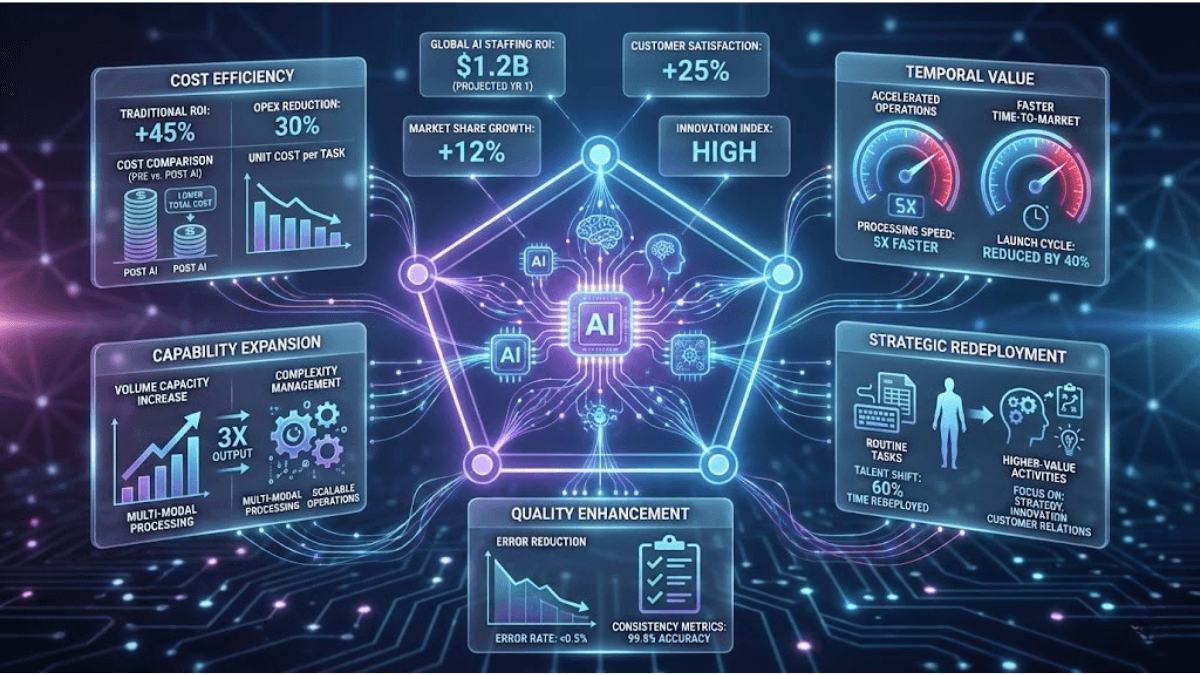
A more complete economic analysis of AI staffing requires expanding beyond cost efficiency to encompass four additional value dimensions:
1. Capability Expansion Value
This dimension captures new organizational abilities enabled by AI agents:
Key Metrics:
- Volume capacity increase (e.g., transactions processed, cases handled)
- Time-to-completion reduction
- Complexity management improvements
- Scope of operations expansion
Calculation Approach:
- Quantify the value of previously impossible or impractical operations
- Measure the impact of processing volumes beyond human feasibility
- Assess the benefits of handling complexity that exceeded previous capabilities
Potential Application: An investment firm implementing AI financial analysis agents could potentially expand its deal evaluation capacity significantly. This might enable the firm to consider many more opportunities without expanding analyst headcount, potentially improving investment quality through greater selectivity.
2. Quality Enhancement Value
This dimension measures improvements in output quality and consistency:
Key Metrics:
- Error rate reduction
- Consistency improvement
- Compliance enhancement
- Customer satisfaction impact
Calculation Approach:
- Quantify the cost of errors and inconsistency in current operations
- Measure the impact of quality improvements on customer retention and satisfaction
- Assess the value of improved compliance and reduced regulatory risk
Potential Application: A healthcare provider implementing document processing agents might significantly reduce billing errors, potentially decreasing claim rejections and improving cash flow. Beyond direct savings, this could improve patient experience and reduce compliance risks.
3. Strategic Redeployment Value
This dimension assesses the impact of redirecting human talent to higher-value activities:
Key Metrics:
- Revenue from new initiatives led by redeployed talent
- Innovation increase from focused human creativity
- Strategic project acceleration
- Employee satisfaction and retention improvements
Calculation Approach:
- Measure the output value of redeployed human resources
- Quantify the impact of increased focus on strategic priorities
- Assess the value of improved employee experience and retention
Potential Application: A professional services firm implementing research agents could potentially redeploy consultants from background research to client advisory roles. This might increase high-value client engagement and could potentially drive revenue growth through more strategic client interactions.
4. Temporal Value
This dimension captures the business impact of speed and responsiveness:
Key Metrics:
- Market response time improvement
- Time-to-value acceleration
- Opportunity capture rate enhancement
- Scaling velocity increase
Calculation Approach:
- Quantify the value of faster decision-making and execution
- Measure the impact of improved responsiveness on market opportunities
- Assess the competitive advantage of accelerated scaling capabilities
Potential Application: A retail operation implementing inventory management agents could potentially reduce market response time from weeks to hours. This might enable more rapid adaptation to emerging trends, potentially increasing seasonal merchandise profitability through better timing.
5. Cost Efficiency Value
This traditional dimension still matters, but should be seen as just one component of ROI:
Key Metrics:
- Direct labor cost reduction
- Infrastructure and overhead savings
- Training and turnover cost decrease
- Management span of control expansion
Calculation Approach:
- Compare all-in costs of human resources to AI agent alternatives
- Account for both direct and indirect cost impacts
- Consider long-term cost trend differences between human and AI resources
Potential Application: A customer service operation implementing support agents could potentially reduce staffing costs while handling higher contact volumes—a straightforward efficiency improvement that serves as the foundation for broader value creation.
Implementation Economics: Maximizing ROI Across Dimensions
To achieve optimal economic returns from AI staffing initiatives, organizations should adopt implementation approaches that maximize value across all dimensions:
Phased Implementation for Early Returns
Sequence AI staffing initiatives to deliver near-term ROI while building toward strategic value:
- Foundation Phase: Begin with high-volume, well-defined processes where cost efficiency and quality improvements provide immediate returns
- Expansion Phase: Extend to areas where capability enhancement creates substantial new value
- Transformation Phase: Redesign workflows and organizational structures to fully leverage human-AI collaboration
This staged approach generates early wins that fund more ambitious initiatives while building organizational confidence.
Strategic Process Selection
Prioritize processes for AI staffing based on multi-dimensional value potential:
- High-Volume, Moderately Complex Operations: Typically offer the strongest combined cost efficiency and quality enhancement returns
- Knowledge-Intensive Analysis Functions: Often yield exceptional capability expansion value
- Client-Facing Operations with Significant Routine Elements: Frequently deliver strong quality and temporal value
- Creative Processes with Substantial Research Components: Typically provide high strategic redeployment value
Processes matching multiple criteria generally deliver the strongest overall ROI.
Human-AI Integration Design
Structure human-AI collaboration to maximize value creation:
- Complementary Design: Assign tasks to humans and AI based on their respective strengths
- Augmentation Focus: Use AI to enhance human capabilities rather than simply replace functions
- Feedback Loops: Create mechanisms for continuous improvement through human-AI interaction
- Strategic Redeployment Planning: Proactively design new roles for talent freed from routine work
Thoughtful integration design dramatically affects value creation across all ROI dimensions.
Organizational Readiness
Prepare the organization to capture full AI staffing value:
- Leadership Alignment: Ensure executive understanding of multidimensional value potential
- Capability Development: Build skills needed to effectively collaborate with AI agents
- Process Redesign Capacity: Develop ability to reimagine workflows around AI capabilities
- Change Management: Prepare the organization for evolving roles and responsibilities
Organizations that invest in these readiness factors typically achieve significantly higher ROI than those focused solely on technology implementation.
ROI Measurement: Tracking Value Creation
Effective measurement of AI staffing ROI requires a comprehensive approach:
Baseline Establishment
Before implementation, document current performance across all value dimensions:
- Cost Structure: Fully loaded costs of current operations
- Capability Metrics: Volume, complexity, and scope limitations
- Quality Indicators: Error rates, consistency measures, and satisfaction metrics
- Strategic Allocation: How talent is currently deployed across value-creating activities
- Temporal Performance: Current response times and scaling capabilities
This baseline provides the foundation for measuring true impact across all dimensions.
Progressive Measurement
Track value creation at multiple time horizons:
- Short-Term Indicators (1-3 months): Immediate efficiency and quality impacts
- Medium-Term Measures (3-12 months): Capability expansion and temporal value
- Long-Term Metrics (12+ months): Strategic redeployment benefits and transformational outcomes
This progressive approach prevents premature value judgments based solely on initial impacts.
Comprehensive Scorecard
Create a balanced view of ROI across all dimensions:
- Financial Metrics: Traditional ROI, payback period, and NPV calculations
- Operational Indicators: Volume, quality, and temporal performance measures
- Strategic Measures: Innovation, growth, and competitive differentiation metrics
- People Factors: Skill development, satisfaction, and retention indicators
This multidimensional scorecard prevents suboptimization by ensuring balance across value factors.
Illustrative Scenarios: Multidimensional ROI Potential
To understand how this framework might apply across industries, consider these hypothetical scenarios:
Financial Services: Wealth Management Firm
Implementation: Deployment of financial analysis and client service agents to support advisory teams
Potential Value Areas:
- Capability Expansion: Increased client capacity with same advisor headcount
- Quality Enhancement: Reduction in service errors and compliance exceptions
- Strategic Redeployment: Advisors potentially shifting from administrative tasks to client-facing time
- Temporal Value: Potential reductions in client onboarding time
Value Creation Potential: The combined impact of these dimensions could potentially exceed the direct cost savings by several multiples.
Healthcare: Provider Organization
Implementation: Document processing, coding, and care coordination agents
Potential Value Areas:
- Capability Expansion: Potential increase in patient capacity without adding clinical staff
- Quality Enhancement: Potential reduction in coding errors, improving appropriate reimbursement
- Strategic Redeployment: Clinical staff administrative time potentially reduced
- Temporal Value: Possible improvements in discharge processing time
Value Creation Potential: The healthcare context often amplifies quality and temporal value due to direct patient care impacts.
Manufacturing: Industrial Components Supplier
Implementation: Supply chain, quality control, and customer service agents
Potential Value Areas:
- Capability Expansion: Potential for 24/7 operations without shift premiums
- Quality Enhancement: Possible reduction in order errors, potentially improving customer retention
- Strategic Redeployment: Engineering time potentially refocused from support to product development
- Temporal Value: Potential reduction in order-to-delivery time
Value Creation Potential: Manufacturing contexts often see particularly strong temporal and quality value due to supply chain implications.
Common ROI Pitfalls to Avoid
Several common mistakes can undermine AI staffing ROI calculations and implementation:
Narrow Implementation Focus
Implementing AI agents solely as direct human replacements:
- Misses capability expansion opportunities
- Ignores quality enhancement potential
- Overlooks strategic redeployment possibilities
- Results in significantly suboptimal returns
Solution: Approach implementation as workflow transformation rather than staff replacement.
Inadequate Redeployment Planning
Capturing cost savings without strategic talent reallocation:
- Wastes the organization's most valuable resource
- Creates resistance and cultural barriers
- Limits strategic value capture
- Often results in capability loss that offsets efficiency gains
Solution: Begin with clear plans for how human talent will be redeployed to higher-value activities.
Over-Reliance on Cost Metrics
Judging success primarily by cost reduction:
- Creates incentives for suboptimal implementation decisions
- Undervalues long-term strategic benefits
- Misses capability and quality enhancement potential
- Often leads to premature scaling back of promising initiatives
Solution: Implement balanced scorecards that measure value creation across all dimensions.
Isolated Implementation
Deploying AI agents within existing organizational silos:
- Limits cross-functional value creation
- Constrains capability expansion potential
- Reduces strategic redeployment opportunities
- Often creates new inefficiencies at process boundaries
Solution: Take an end-to-end process view rather than a departmental implementation approach.
Future Economic Trends in AI Staffing
Several emerging developments will shape the economics of AI staffing in coming years:
Cost Structure Evolution
The relative costs of human and AI resources continue to evolve:
- AI agent deployment costs continue to decline annually
- Human workforce costs continue to rise in most knowledge work domains
- The crossover point where AI agents represent the more economical option continues to expand across functions
This evolution continuously expands the domains where AI staffing delivers positive ROI.
Capability Acceleration
AI agent capabilities are advancing at a remarkable pace:
- Reasoning capabilities are expanding into increasingly complex domains
- Specialized expertise is deepening across professional disciplines
- Collaboration abilities are enhancing integration with human teams
- Adaptation capabilities are reducing implementation customization requirements
These advances continuously increase the value creation potential across all ROI dimensions.
Integration Sophistication
Human-AI collaboration models continue to mature:
- More natural interaction paradigms are reducing friction
- Enhanced explanation capabilities are building trust and effectiveness
- Progressive learning from human feedback is improving alignment
- Team-based approaches are replacing individual agent implementations
These developments significantly enhance value creation, particularly in strategic redeployment and capability expansion dimensions.
Organizational Transformation
Leading organizations are moving beyond process-level implementation:
- Rethinking organizational structures around human-AI collaboration
- Reimagining business models based on expanded capabilities
- Developing new management approaches for blended teams
- Creating hybrid operating models that maximize comparative advantages
These transformations dramatically amplify ROI potential across all value dimensions.
Conclusion: The Strategic Imperative of Comprehensive ROI
As AI staffing capabilities continue to mature, the organizations that achieve the greatest economic returns will be those that adopt a comprehensive view of value creation rather than focusing solely on cost efficiency. This broader perspective isn't just about measurement—it fundamentally shapes implementation strategy, prioritization decisions, and organizational approach.
The most successful organizations recognize that the economics of AI staffing extends far beyond labor cost reduction to encompass:
- Capability expansions that were previously impossible
- Quality enhancements that transform customer experience and regulatory compliance
- Strategic talent redeployment that accelerates innovation and growth
- Temporal advantages that create significant competitive differentiation
By approaching AI staffing initiatives through this multidimensional lens, organizations can potentially unlock value that is significantly greater than what would be achieved through a cost-focused approach alone.
AiStaff's AI agent solutions are designed to deliver this comprehensive value—providing not just cost efficiency but capability expansion, quality enhancement, strategic redeployment opportunities, and temporal advantages. Our implementation methodology focuses on maximizing value across all dimensions, helping organizations achieve the full economic potential of AI staffing rather than settling for modest efficiency gains.
Discover how AiStaff can help your organization achieve multidimensional ROI through thoughtful integration of specialized AI agents into your operations and strategy.
Related reading: What Exactly is an AI Agent? | Introducing the AI C-Suite | Building Your First Custom AI Agent